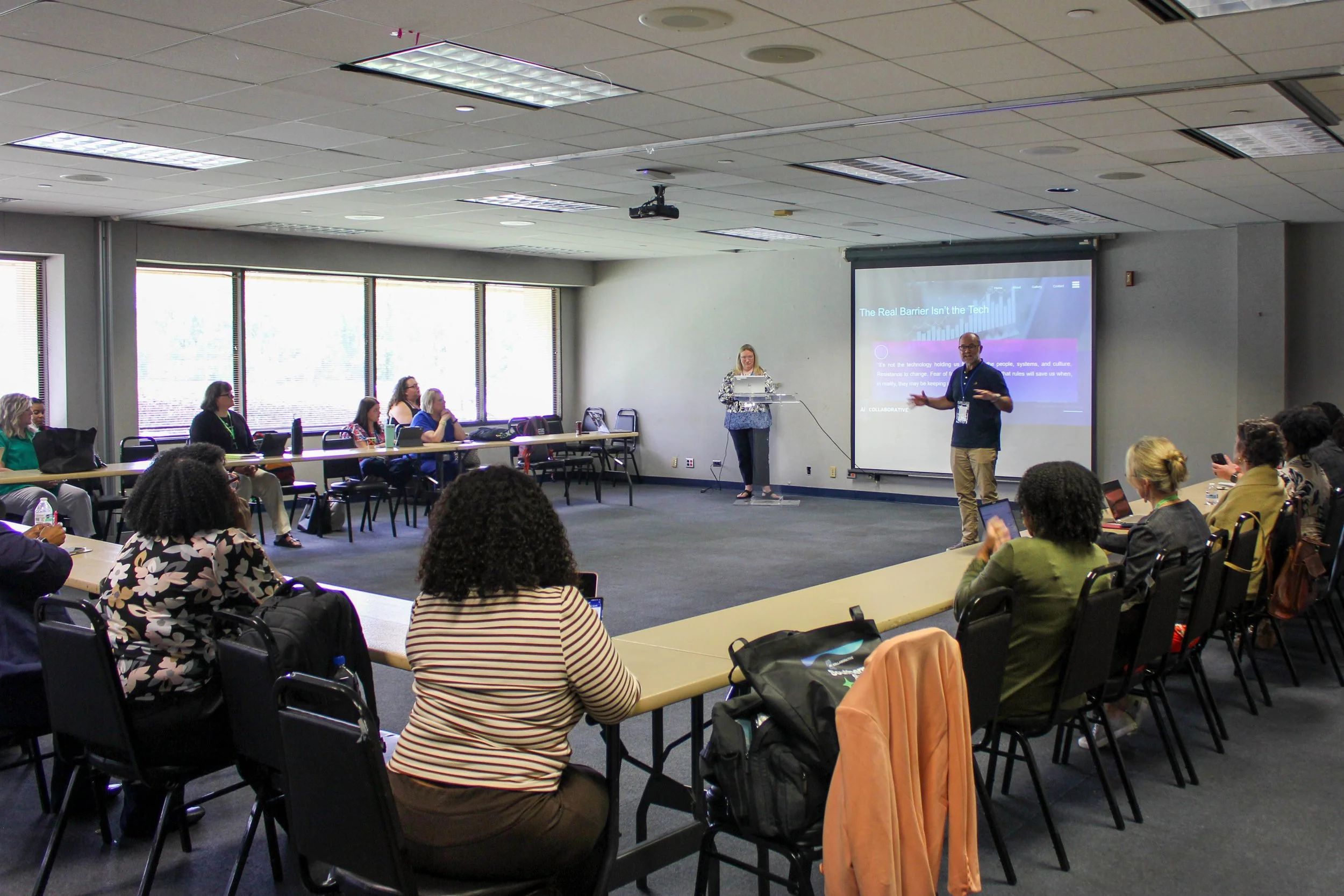
Mississippi community members working through practical AI guidance together
Research-informed guidance built for use with other people
Policy template · Policy builder + checklists

Business AI Policy Template

Set expectations for workforce use, customer interactions, privacy, security, HR, procurement, and responsible adoption.

Business
Adapt before adopting

Policy should fit the people and work it governs.

Use the template with local leadership, workers, learners, and affected communities. Confirm the rules that apply and name who can answer questions, approve exceptions, and correct harm.

EditionEdition 1.0
Last reviewedOctober 27, 2026
Review bodyMississippi AI Collaborative
Board leadKrystal Chatman
Next reviewApril 2027, or sooner after a material source change
Report a correction
Core message

AI should create measurable value without exposing customers, workers, intellectual property, security, or the trust a business depends on.

What you will leave with

A practical business policy covering employee use, customer interactions, marketing claims, HR, confidential information, vendors, security, and accountable approval.

Start here

Ask these five questions first.

  1. 01

    What business problem is being solved and how will value be measured?

  2. 02

    Could customer, employee, financial, credential, or proprietary information enter the system?

  3. 03

    Could the output affect employment, pricing, credit, eligibility, safety, or customer trust?

  4. 04

    Can a qualified person verify and correct the result before harm occurs?

  5. 05

    Do the vendor terms, total cost, security, ownership, and exit plan support the business?

Words that change the meaning

Know the distinctions.

Approved AI use
A documented purpose, tool, information flow, reviewer, and set of safeguards authorized by the organization.
Sensitive information
Information that could identify, expose, stigmatize, endanger, or materially affect a person or organization.
Consequential decision
A decision affecting rights, access, opportunity, employment, education, health, safety, finances, or essential services.
Meaningful human review
Review by a person with the information, expertise, time, and authority to question an output and change the result.
AI incident
A privacy, security, safety, fairness, deception, accessibility, or unauthorized-use failure involving an AI system.
Retirement
A documented process for stopping a use, preserving required records, exporting needed data, and removing access safely.
Evidence behind this guide

Why this policy protects people while supporting small businesses and employers.

These primary and authoritative sources shaped the policy’s rules, review points, and accountability structure.

01 · Federal small-business guidanceUpdated 2025

AI for Small Business

U.S. Small Business Administration

What we learned

SBA identifies practical AI uses while emphasizing review, data protection, cybersecurity, intellectual property, transparency, and careful vendor selection.

How it shaped this resource

It shapes the bounded-pilot, human-review, information-protection, workforce, and vendor sections.

Read the original source ↗
02 · Federal consumer-protection guidanceCurrent guidance

Business Guidance

Federal Trade Commission

What we learned

The FTC emphasizes that existing consumer-protection and anti-discrimination law applies to automated systems and unsupported claims remain unlawful.

How it shaped this resource

It supports the truthful-marketing, customer-impact, employment-fairness, evidence, and remedy requirements.

Read the original source ↗
03 · Federal risk framework2023

Artificial Intelligence Risk Management Framework 1.0

National Institute of Standards and Technology

What we learned

NIST organizes continuous AI risk work around governance, context mapping, measurement, management, monitoring, incident response, and retirement.

How it shaped this resource

It shapes the inventory, approval roles, risk review, testing, monitoring, incident response, and retirement requirements in this template.

Read the original source ↗
04 · Federal cybersecurity guidanceCurrent resource collection

Secure Our World: Stay Safe Online When Using AI

Cybersecurity and Infrastructure Security Agency

What we learned

CISA advises people not to put sensitive information into AI tools, warns about AI-enabled deception, and emphasizes account security and human expertise.

How it shaped this resource

It supports the input restrictions, security controls, synthetic-media rules, training expectations, and incident reporting steps.

Read the original source ↗

Sources and requirements can change. Check the publication date, read the original material, and confirm the rules that apply locally before making a consequential decision.

Understand the choices

Put responsible AI into practice for small businesses and employers.

Use these policy areas to turn values into decisions, responsibilities, safeguards, and remedies people can understand.

01

Workforce rules

Tell employees which tools and tasks are approved, what information is prohibited, when disclosure is required, and who reviews customer-facing or consequential work.

02

Customers and marketing

Keep advertising, reviews, testimonials, pricing, support, and product claims truthful. Clearly identify bots where a person could reasonably believe they are dealing with a human.

03

Employment and fairness

Do not use AI to screen, rank, monitor, evaluate, discipline, or terminate workers without qualified review, job-related evidence, bias assessment, notice, and a correction route.

04

Security, vendors, and continuity

Protect credentials, contracts, trade secrets, financial data, and customer records. Review integrations, model training, subcontractors, incident notice, cost growth, export, and shutdown.

Make a plan

Build your policy step by step.

0 of 7 completeSaved on this device
Good places to begin

Use AI to support the work.

✓ Drafting internal outlines from public or fictional information

✓ Summarizing non-sensitive material for a person to verify

✓ Testing a bounded workflow against time, quality, cost, and error baselines

Stop and reconsider

Do not hand over the judgment.

× Uploading customer, employee, financial, credential, contract, or trade-secret information to unapproved tools

× Automated hiring, firing, pricing, credit, safety, or eligibility decisions

× Publishing invented reviews, testimonials, statistics, citations, or unsupported AI claims

Use the tools

Build the policy and the operating tools behind it.

Adapt the clauses and complete the reviews with the people responsible for the work and the people affected by it.

Policy starter

Business core policy clauses

Adapt these clauses for formal review and approval.

0 of 8 checked
Interactive checklist

AI use approval review

Complete before approving a pilot, workflow, purchase, or embedded feature.

0 of 7 checked
Review tool

Vendor due-diligence questionnaire

Use before signing, renewing, or expanding a service.

0 of 8 checked
Action plan

AI incident response card

Use when information, people, decisions, or trust may have been harmed.

0 of 6 checked
Practice together60 minutes

Business AI Policy Workshop

Turn one proposed business workflow into a measurable approval decision and clear employee rule.

  1. 1

    Choose one workflow and record the current time, cost, quality, and error baseline.

  2. 2

    Map customer, employee, financial, proprietary, and vendor information.

  3. 3

    Complete the approval and vendor reviews.

  4. 4

    Classify the use and write one allowed and one prohibited example.

  5. 5

    Set a 30-day pilot owner, reviewer, measures, disclosure, and stop condition.

  6. 6

    Ask a worker and an affected customer what the policy overlooks.

Talk about it

Would the business still stand behind the output if a customer, employee, regulator, or partner asked how it was produced?

Before you act

Share the plan with the people responsible for the work and the people who may be affected. Confirm local rules, protect private information, and name the person who can answer questions or correct a problem.