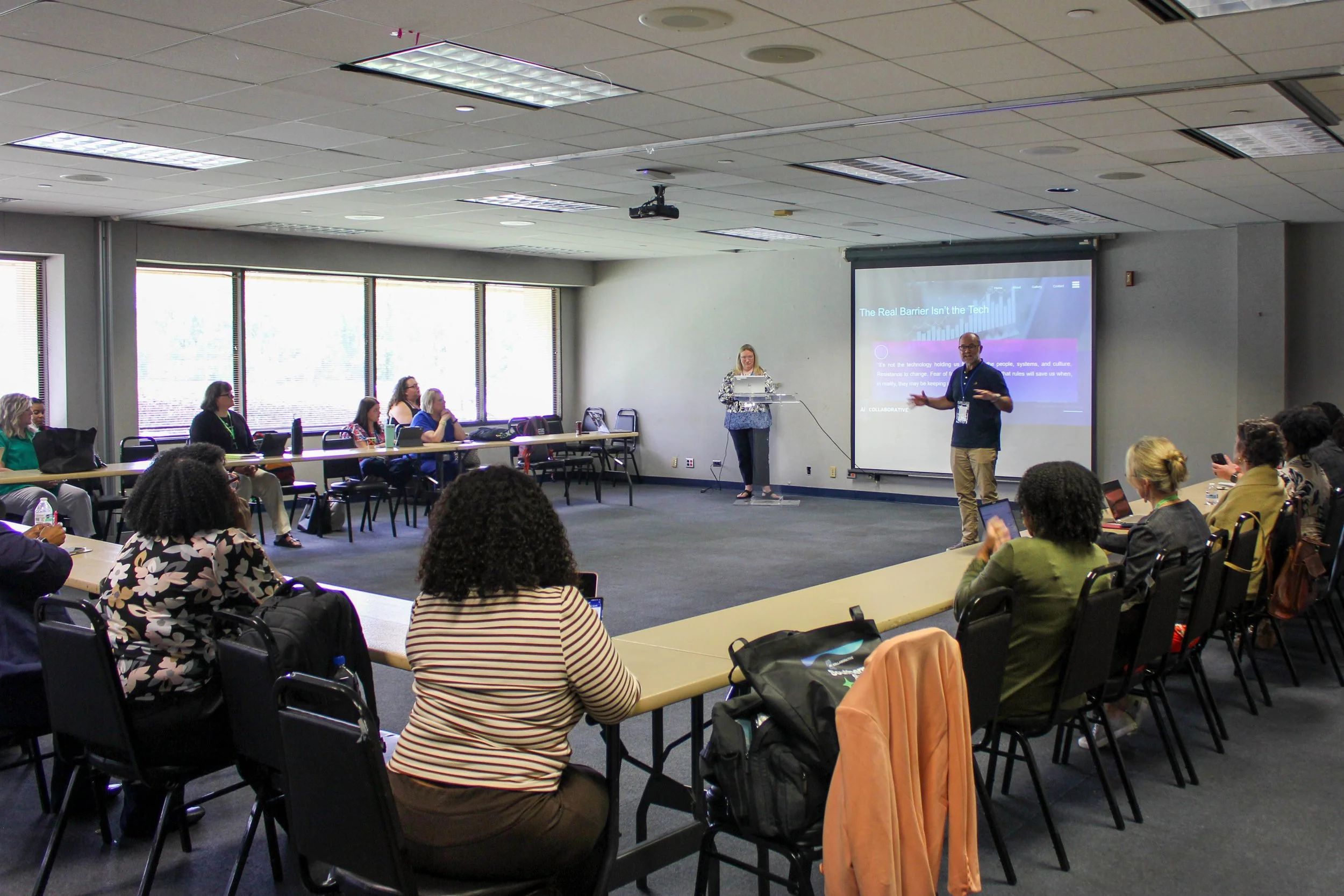
Mississippi community members working through practical AI guidance together
Research-informed guidance built for use with other people
Policy template · Policy builder + checklists

Nonprofit & Community AI Policy Template

Protect donor and client data while governing fundraising, grant work, programs, volunteers, accessibility, and incident response.

Nonprofits
Adapt before adopting

Policy should fit the people and work it governs.

Use the template with local leadership, workers, learners, and affected communities. Confirm the rules that apply and name who can answer questions, approve exceptions, and correct harm.

EditionEdition 1.0
Last reviewedOctober 27, 2026
Review bodyMississippi AI Collaborative
Board leadKrystal Chatman
Next reviewApril 2027, or sooner after a material source change
Report a correction
Core message

AI may support the mission, but it must never weaken the trust, dignity, privacy, or voice of the people a nonprofit serves.

What you will leave with

A board- or leadership-ready AI policy with defined uses, protected information, approval roles, vendor requirements, disclosure practices, and a response plan when something goes wrong.

Start here

Ask these five questions first.

  1. 01

    Does this use directly advance the mission, and is AI better than a simpler approach?

  2. 02

    Could the tool receive information about a client, donor, volunteer, employee, partner, or community member?

  3. 03

    Could an error affect access to services, funding, employment, safety, reputation, or dignity?

  4. 04

    Can the organization explain the use, provide an accessible alternative, and correct a harmful result?

  5. 05

    Who has authority to approve, monitor, pause, and retire this use?

Words that change the meaning

Know the distinctions.

AI system
A tool that generates, predicts, recommends, classifies, ranks, or otherwise produces an output from data or instructions.
Sensitive information
Information that could identify, expose, stigmatize, endanger, or materially affect a client, donor, employee, volunteer, partner, or community member.
Consequential decision
A decision that can affect services, benefits, employment, safety, eligibility, reputation, legal rights, or another meaningful opportunity.
Approved tool
A system reviewed for its purpose, data practices, security, accessibility, terms, cost, ownership, and exit requirements—not merely a tool someone can access.
Meaningful human review
Review by a person with enough information, authority, time, and expertise to question the output and change the decision.
AI incident
An event involving exposed information, harmful or discriminatory output, deception, security failure, unapproved use, or a decision the organization cannot explain or correct.
Evidence behind this guide

Why mission, privacy, accessibility, and accountability all belong in one policy.

The source guidance treats AI risk as an organizational responsibility across the full lifecycle. For nonprofits, that means connecting governance to donor trust, client dignity, equitable access, third-party tools, and practical ways to correct harm.

01 · Federal risk frameworkPublished January 2023

Artificial Intelligence Risk Management Framework 1.0

National Institute of Standards and Technology

What we learned

NIST treats AI risk management as a continuous organizational practice across governance, context mapping, measurement, management, monitoring, incident response, and decommissioning.

How it shaped this resource

We use it to structure ownership, the use inventory, risk classification, approval evidence, monitoring, incident response, and retirement decisions.

Read the original source ↗
02 · Federal privacy frameworkVersion 1.0 and current program resources

NIST Privacy Framework

National Institute of Standards and Technology

What we learned

NIST defines privacy risk around problems people may experience from data processing across the full data lifecycle and connects those harms to organizational accountability and vendor relationships.

How it shaped this resource

We use it to frame data minimization, affected-person impact, vendor requirements, retention, deletion, and privacy review as mission and governance responsibilities.

Read the original source ↗
03 · Federal cybersecurity guidance2024

Stay Safe Online When Using AI

Cybersecurity and Infrastructure Security Agency

What we learned

CISA advises people not to share sensitive or confidential information with AI systems, warns about AI-enabled deception, and emphasizes core account-security practices and human expertise.

How it shaped this resource

We use it in the sensitive-data prohibition, staff training, account controls, incident reporting, and restrictions on deceptive synthetic media.

Read the original source ↗
04 · Federal accessibility guidancePublished March 2022

Guidance on Web Accessibility and the ADA

U.S. Department of Justice

What we learned

The guidance explains how inaccessible digital content can deny people equal access and identifies practical barriers such as low contrast, missing text alternatives, uncaptured video, inaccessible forms, and mouse-only navigation.

How it shaped this resource

We use it to require accessible communications, interfaces, forms, media, and non-AI alternatives when technology affects access to nonprofit information or services.

Read the original source ↗
05 · Nonprofit governance guidanceCurrent sector guidance

Good Governance Policies for Nonprofits

National Council of Nonprofits

What we learned

The Council connects written policies with board oversight, documentation, recurring review, whistleblower protection, records practices, and public trust.

How it shaped this resource

We use it to place AI policy within existing nonprofit governance, board review, recordkeeping, reporting, and accountability practices instead of treating AI as a separate technology exercise.

Read the original source ↗

Sources and requirements can change. Check the publication date, read the original material, and confirm the rules that apply locally before making a consequential decision.

Understand the choices

Turn organizational values into rules people can actually follow.

Use these six policy areas to decide who may use AI, for what purposes, with which information, under whose review, and with what remedy for affected people.

01

Purpose, scope, and authority

State why the organization is adopting the policy, who and what it covers, and who owns it. Include employees, contractors, volunteers, board members, interns, vendors, free tools, paid tools, and AI features added to software the organization already uses.

  • Name a policy owner and an approval body.
  • Apply the policy to experiments as well as routine use.
  • Set a review date and a route for exceptions.
02

Allowed, reviewed, and prohibited uses

Separate low-risk support from uses that require review or should not proceed. Risk depends on the people, information, decision, and potential harm—not whether the tool feels familiar.

  • Allow low-risk drafting or brainstorming only with non-sensitive information and human review.
  • Require approval for public communications, client-facing materials, analysis, fundraising, or program recommendations.
  • Prohibit autonomous decisions about services, eligibility, employment, discipline, safety, or benefits.
03

Data stewardship and consent

Collecting information for a program, donation, or employment purpose does not automatically authorize sending it to an AI provider. Minimize inputs, use fictional or de-identified examples when possible, and document what vendors retain, reuse, train on, or disclose.

  • Never enter case notes, protected records, donor details, credentials, or confidential partner information into an unapproved tool.
  • Explain material new uses of community information in plain language.
  • Set retention, deletion, access, and breach-response expectations.
04

Accuracy, fairness, and accessibility

Require checks that match the stakes. Review facts against original sources, test whether different communities experience different errors, and provide accessible formats and a non-AI path when the tool creates a barrier.

  • Do not treat fluent language as evidence of accuracy.
  • Include people with relevant lived and professional experience in review.
  • Do not use color, automation, or a chatbot as the only way to receive essential information or services.
05

Fundraising, communications, and program work

Generated grant narratives, donor messages, images, translations, reports, or client materials remain the organization’s responsibility. Claims must be truthful, permissions respected, community stories handled with dignity, and material AI involvement disclosed when it affects trust or understanding.

  • Never invent a client story, quotation, outcome, partner, citation, or statistic.
  • Do not create a synthetic likeness or voice of a real person without informed permission.
  • Have a knowledgeable person review translations and culturally specific communication.
06

Vendors, incidents, and continuous review

Before adoption, document the vendor, purpose, information, contract terms, security, accessibility, evidence, cost, and exit plan. After adoption, log material failures, complaints, overrides, and changes; pause the use when safeguards no longer work.

  • Name who receives an incident report and who can stop the system.
  • Tell affected people what happened and how to seek correction when appropriate.
  • Reapprove material changes in the tool, purpose, data, or population served.
Make a plan

Build your policy step by step.

0 of 8 completeSaved on this device
Good places to begin

Use AI to support the work.

✓ Drafting internal outlines from public or fictional information for a person to revise

✓ Creating alternative reading levels or formats after accessibility and accuracy review

✓ Summarizing non-sensitive meeting notes with participant notice and human correction

✓ Exploring program ideas before community consultation and organizational approval

Stop and reconsider

Do not hand over the judgment.

× Uploading client files, donor records, personnel information, credentials, or confidential partner material to an unapproved tool

× Automatically ranking people for services, aid, employment, discipline, risk, or opportunity

× Inventing stories, testimonials, outcomes, statistics, citations, partners, or community consent

× Using synthetic images, voices, or identities in ways that could deceive, exploit, or misrepresent people

Use the tools

Build the policy—not just a list of intentions.

Work through the policy clauses, approval matrix, data review, vendor questions, disclosure language, and incident plan. Checked items are saved on this device.

Policy starter

Core policy clauses

Adapt these clauses into language your board or leadership can review.

0 of 8 checked
Interactive checklist

AI use approval checklist

Complete this before approving a new workflow, pilot, or embedded AI feature.

0 of 8 checked
Interactive checklist

Data protection checklist

Use this before anyone sends information to an AI system.

0 of 8 checked
Review tool

Vendor review questionnaire

Questions to answer before signing, renewing, or expanding a service.

0 of 8 checked
Disclosure template

Public AI-use disclosure

Plain-language elements for a report, communication, service, or public-facing workflow.

0 of 6 checked
Action plan

AI incident response card

Use immediately after a privacy, safety, fairness, deception, or unapproved-use concern.

0 of 6 checked
Practice together60 minutes

Nonprofit AI Policy Workshop

Use one real or proposed workflow to turn this template into decisions your organization can adopt.

  1. 1

    Choose one workflow such as grant drafting, donor communication, translation, meeting notes, client intake, or program reporting.

  2. 2

    Map the people affected, information used, intended benefit, non-AI alternative, and worst credible failure.

  3. 3

    Complete the approval and data-protection checklists; mark every unanswered item as a condition that blocks approval.

  4. 4

    Classify the workflow as allowed, approval required, or prohibited and write the reason in plain language.

  5. 5

    Adapt the relevant policy clauses, assign an owner, and name the evidence that will be reviewed after 30 days.

  6. 6

    Ask a program participant, accessibility reviewer, or community representative what the draft overlooks before leadership approval.

Talk about it

Would a person receiving services understand the policy, feel respected by the workflow, and know how to reach someone who can correct a problem?

Before you act

Share the plan with the people responsible for the work and the people who may be affected. Confirm local rules, protect private information, and name the person who can answer questions or correct a problem.